All forward motion counts

img_2419

On my last day of CBT, I spent the full session sitting in my chair sobbing uncontrollably, muttering ‘I’m sorry’ in between gasps for air, ‘I don’t know why this is happening’.

A few weeks before Christmas, I self-referred to a local mental health clinic in an attempt to gain control over my thoughts and to learn coping strategies when things felt like they were spiralling out of control. It was something I’d always thought I should do, but never felt I was ‘bad enough’ to require outside guidance. I’m fiercely independent, and I always want to be able to take care of myself without anyone’s help or input. But as my husband’s condition was worsening and the future was quickly filling up with more and more unknowns, I realised now was the time to admit that I needed help. I genuinely felt like I couldn’t face whatever came next for his treatment unless I was properly prepared. So I signed up for a 6-week CBT one-to-one course (cognitive behavioural therapy), intended to analyse the way I reacted to situations, then work to implement changes to disrupt the negative pattern I had fallen into. It sounded like the perfect thing for me to do: it would be work, but it would come with noticeable results.

I kept it quiet from most everyone. I didn’t want anyone to know that I was working on myself because I didn’t want to admit that 1) there was anything that needed fixing and 2) that it was affecting anything more than myself. To be completely honest, I was so stressed and so panicked and so overwhelmed that it was affecting a lot in my life. My anxiety had gotten so extreme that I wasn’t leaving the house except to go to work, and even there I wasn’t myself. I needed help, but I didn’t need to broadcast it to everyone. I wasn’t ready for that.

So I went home to America for the holidays and tried my best to relax during my time off knowing that when I returned, it was time to get to work. And I did. Every week, I went in for my appointment and talked about how I react to situations and how they’re affecting me and how I thought I could change that. I’m not a therapist, but CBT itself is pretty straight forward. It’s goal-oriented and something you can track progress on paper. Each session I’d walk in with my homework in hand ready to discuss it, and each week I was transparently told how well I was doing. I felt pretty proud of myself, and received the positive affirmations I needed each week to keep me working toward a better me. I was slowly breaking the pattern that I knew played a major role in my recent demise. I was clawing my way back up to the surface each week, and for the most part, it felt pretty damn productive.

On my last day of therapy, I had recently gotten incredibly stressful news about my husband. He was due to get DRG surgery in the coming months, but we hadn’t yet been given a date for the surgery (a type of spinal cord stimulation targeting your dorsal root ganglion nerve bodies at the base of the spinal cord). We were just anxiously awaiting a phone call from the hospital that could’ve literally come any day, which meant most of our life plans were on hold or tentative until we knew what was going on with his surgery. A very tense way to live your life, let me tell you. Anyway, we got that call, suddenly, when we weren’t expecting it in the slightest. But it wasn’t the call that threw me – it was that the hospital called to ask if he could come in for surgery three days later. It’s one thing to know you’re waiting for life-changing surgery, but it’s something completely different when you’re asked to get it done in mere days! However, I thought I handled that experience with ease: I was calm, strategic and gave my husband logical advice. When we finally determined it wasn’t the right time to drop everything for the surgery and we’d rather wait for a later date in which we could plan properly, I hung up the phone feeling proud of myself for handling it like a mature adult. Pre-therapy Tanya would’ve completely crumbled from the stress of the situation, over the need to give the hospital an answer within the hour. Panic would’ve taken over and I would’ve been crying in the bathroom desperately trying to compose myself before getting back to work. But not this time! This time I handled it like a pro, and although I still felt a little jittery from the whole ordeal, I survived and I was able to get back to work comfortably. Or so I thought.

When I eventually had my final therapy appointment, I walked in prepped and ready to tell my therapist how I dealt with a scary, overwhelming scenario like a boss. A ‘look how much I’ve learned already’ show of achievement. I walked in smiling, sat down and started explaining how the situation came up and how I responded to it, and the minute my therapist asked what I would’ve done if my husband had taken the early surgery date… I burst into tears. And they didn’t stop. The entire session. I kept apologising and muttering that I didn’t know why this was happening and I was fine the whole time until I walked in that door and how it didn’t make sense and that I was sorry, sorry, sorry. She told me it was a completely normal, emotional reaction and it just showed how much I cared about my husband, and how that type of worry is and will still be normal. She explained the stress of his medical situation is unique and how I need to stop viewing my tears as weakness. I don’t remember every detail of that appointment mostly because I was utterly embarrassed and surprised at my own reaction. I mostly remember her telling me I was strong and proactive, but that maybe I needed something a little more than CBT and gently suggested I pursue treatment elsewhere. I know she meant well, and I know she’s probably right – I need treatment catered specifically to me and my situation because it’s too, uh, complex, for generic therapy plans. But I couldn’t help feeling like I had failed therapy. I was doing so, so well only to completely lose it on my last day with an emotional reaction I didn’t even know was in me. I thanked her for everything she had taught me along the way, asked her to send me info for further treatment and took my sobbing self to the bathroom to cry in peace. My husband eventually had to meet me on the walk home since it became evident I wasn’t going to compose myself any time soon.

At the end of all this, we did get an appointment date through for his surgery. It’s in a few weeks time, actually. We were able to go away on holiday beforehand to get some sun and proper relaxation before life as we knew it will change. I haven’t yet signed up for new therapy. I still don’t know if I will, and I imagine it hinges on whether or not this surgery goes well. But for now, I’m applying what I have learned so far: I don’t know what will happen after this surgery. I don’t know if it will be the saving grace we’re after or if it’ll send us back to square one. But I do know that these ‘what ifs’ are not helpful, and we’ll tackle the outcome when that day arrives. And I’m still trying to remind myself that I am strong and despite feeling weak more often than not, I have every right to be proud of how far I’ve come so far. This stuff is absolutely terrifying. I wouldn’t wish any of this on my worst enemy. I know I’m going to be emotional when his surgery date arrives, but I know I’ve got some tools to help myself this time around. And if I find myself falling short – I have options. That, in itself, is empowering. There’s no reason I should ever feel I’m going this alone. And it’s about damn time I realised that.

You’re looking for the explanation, the loophole, the bright twist in the dark tale that reverses your story’s course. But it won’t reverse – for me or for you or for anyone who has ever been wronged, which is everyone. Allow your acceptance of the universality of suffering to be a transformative experience. You do that by simply looking at what pains you squarely in the face and then moving on. You don’t have to move fast or far. You can go just an inch. You can mark your progress breath by breath.
Life now

13880394_10154406098136350_5826270149240278047_nLet me tell you about chaos.
Explain how it does not tear you apart, but seethes and simmers within, building in strength with each passing day, growing in intensity like water to boil.

And when the heat reaches your skin, all you want is to peel it off and run, frantic, panicked – because you thought that was your only option when you only had seconds to decide.
And oh, how you wish you hadn’t.
Let me tell you about chaos and how it destroys every shred of hope you once held, but selectively.
Bit by bit, they evaporate into thin air and all you have left is the thought that you really needed that.
But too late now.
There is no screaming, there is no sound.
You remember the silence most, as the whole world around you spins wildly out of control.
As your body betrays you and breaks down, slowly, and then suddenly.
You close your eyes to rest, and wake up to do it all over again.
Let me tell you about chaos.

This is now the sixth time I’ve started writing this blog. The last times I gave up after writing a few sentences, unable to put my thoughts into words. Not sure how much information I wanted to put out to the world, or if I was ready to even accept any of it myself. Then one day, as I was struggling to keep myself together, I found I needed to write what my feelings were as they were coming out. And so another of my many poems was borne, and here I am again trying to talk about the chaos that I call this life.

I’m familiar with struggle and I’m friendly with perseverance. I’ve grown used to my pathway being paved with difficulties to overcome, and my track record of success is thankfully greater than my failures. I work hard, I work tirelessly and I hope it pays off in the end. But that’s the thing – I expect there to be an end of some sort. No matter how tough things become, I’m able to keep moving forward because I feel that at some point, the difficult times will pass and I’ll get through it. That’s how we survive, isn’t it? On the faith that those times will pass. We hope to live.

But how do you keep forging ahead when that isn’t a possibility? How do you pick yourself up and keep going when you know, for a fact, that the odds of improvement, of a better life even, aren’t in the cards? Then what?

Most people are aware that my husband is disabled. Most people don’t, however, fully grasp the severity of it. And let me be clear: I do not seek pity. I do not want anyone to feel sorry for me or for my husband, but on some level, I wish they could understand better so they know how to act around us.

His condition is rare. And even as I type that, I want to stress how genuinely rare it is. Only a handful of doctors in the entire world are qualified to properly treat it, and even those doctors all have varying levels of comprehension and understanding. I’ve lost count of the number of occasions where we completely stumped a doctor. Imagine that frustration.

The nervous system is incredibly complex and intricate, so the medical world only understands a small percentage of it with any level of expertise. And CRPS happens to be one of those lovely conditions that manifests differently in people, and is only diagnosed after every other possible medical problem in history is first ruled out. A diagnosis of elimination instantly tells you how little anyone understands it. And the pain my husband experiences because of this disease is intense. It’s akin to the sensation of breaking a bone… many, many times during the day and then never having it heal. One doctor compared it to child birth pain. Now, I’ve never had a kid myself, but I’ve certainly heard plenty about the experience to appreciate the level of strength my husband must have for dealing with constant, chronic pain of this level on a regular, frequent basis.

After many surgical attempts, including killing nerve endings, embedding nerves to trick the brain into thinking it was no longer there, bone surgeries, injections, tests, trials and a million other last-ditch efforts to give him relief, we wound up with one last option left on the table. The treatment is called spinal cord stimulation (SCS). Sounds pretty intense, doesn’t it? Well, that’s because it kind of is. Essentially, it’s one of the only treatments for CRPS sufferers known to improve quality of life, even if some cases turn out to be temporary relief. Much like a pace maker, it’s an implant that goes right into your back with wires connecting to your spinal tissue. The pack sends electrical messages to your brain to dampen pain signals. Neuromodulation manages pain signals, but does not cure the condition. It is not a cure. There is no cure. But if SCS lowers someone’s pain by even 50%, they view that as a success. But with all things related to CRPS, there is no way of knowing if 1) SCS will help someone or 2) how long it could help someone if it proves a success. We thought, however, a 60-70% success rate among other CRPS sufferers was a high enough number for us to give it a go. Even now, we haven’t allowed ourselves to speculate how it would affect us if he doesn’t respond to SCS. We simply can’t consider that at this point.

Since starting the trial programme in which an army of medical professionals work together as a team to determine whether or not my husband is mentally, physically and emotionally stable enough to continue with such a serious procedure, more problems have come to light. Of course, right? Because it’s not enough that he has an incurable disease that will likely only worsen in time. It has to be even more complex.

Although no one seems to understand why exactly, CRPS is known to spread from one limb to another, or all, after time. There’s no rhyme or reason to where it spreads, it just can. My husband has it in his left foot, and in the last month, it’s seemingly spreading to his left hand now. Except! Get this – it appears to be another form of CRPS. DIFFERENT to the type he has already. He’s only had an official diagnosis on his foot for a few years, and to now be starting the process all over again for a different body part is… exhausting, to say the least. And horrifying. It’s still early stages, we think, but we’ve already begun ruling out any and all other possibilities with weekly tests and hospital visits. So the hope of SCS putting an end to the incessant misery his foot was causing was quickly replaced with fear and worry that this new development would not only affect his candidacy for SCS, but also progress to the level of pain he experiences in his foot already. This was our worst case scenario coming to life. Again, you take away the hope of a better life, what does that leave you?

I know he’s struggling, but I can’t speak for him. I’m not him. I don’t feel the same things he feels. But I do my best to show support and strength even though I absolutely do not feel I’m doing it well. I watch him hurt, I watch him panic, I watch him sink deeper into a depression that I’ll never be able to fully understand because whilst I can empathise, I don’t feel what he feels. I never worry about my being able to walk, or whether or not I can pick up a glass of water. But I watch my husband do it every day now. I have to stand by, helpless, watching him hurt and watching him stress about how to go about a “normal” life when he’s nowhere near the level of an able-bodied person. Taking the stairs is a challenge. Today, I watched him get emotional because he couldn’t pick up his burger. And all I can do is remind him that I love him and that we’ll get through this… even when I’m not so sure we can. I worry that I sound selfish when I talk about his condition, but I’m the only person who can talk about how this whole situation affects me. And he’s the only person who can talk about how it affects him. I’m scared. I’m scared for him, I’m scared for me and I’m scared for our future. We still have so many questions that will likely never be answered. Take a moment and imagine how that could possibly feel. Having a doctor tell you, “this likely won’t get better. This will probably spread to other parts of your body. This treatment may not help you.” There are no definites in any of this. And for two people who like to know all the answers, it certainly hasn’t been an easy pill to swallow.

There are moments when I’m so consumed by emotion that I simply cannot function. I get up and walk out of my office several times a day when I feel tears well up. I am constantly bombarded by friends, family and colleagues who genuinely mean well when they ask how things are going, but are actually forcing me to revisit a subject that is physically painful for me to discuss. When I met my husband, he wasn’t disabled yet. He didn’t have CRPS. And since we’ve been together, I’ve been forced to watch it degrade and become worse and worse and not being able to do a damn thing to help. And at this point in life, when we were at the brink of hopefully having relief with SCS, we’ve been ripped back down to earth to face an ugly new reality. And we weren’t ready for that. I’m still not ready for it. But this life doesn’t wait for you to be ready. And I’m angry. Scared. Wishing I could fix everything to give my husband the life, and physically-capable body, I feel he deserves. We’ve been dealt so many awful cards in the four years we’ve been together, that at this point, it all feels like a cruel joke.

I want you to understand that we are suffering. We are mourning the life we had planned for ourselves and trying to accept the one we were given instead. It is not an easy task, especially when it feels like nobody understands. Don’t tell us things will get better. We aren’t foolish enough to cling to such a dangerous hope. Tell us we’re strong. Tell us we’re capable of making the most out of a horrible situation. Tell us we’re handling it well even if you catch us having a breakdown (which we do, frequently). I don’t need you to feel sorry for me, either. Yes, I’m struggling and I’ll never deny that. But as much as I’ve wanted to all throughout this journey, I will not give up. I simply can’t. We are stronger than this pain, and I aim to prove that until my last breath.

“Be kind. For everyone you meet is fighting a battle you know nothing about.”

Finding home

12241591_10153788546021350_2546363106105606442_n-1It’s been six months since I’ve officially relocated to the UK, and to say it’s been a rollercoaster ride is a slight understatement. I anticipated an adjustment period, considering the fact that I was leaving behind everything familiar and opting for complete immersion into a new home, new environment and new people. But despite having lived in the UK for a few months in the summer of 2012, it was far more destabilising this time around. I think the fact that this move was permanent contributed to that emotion. But six months in, I think I’ve found my centre at last… and the ability to write as if I were a native Brit.
Anxious excitement dominated my first month or two, which makes sense because I was eager to close the gap and be here, but I had no idea what life would be like once I actually moved. That realisation started to seep into my brain toward the end of my second month, beginning of the third. My excitement quickly turned serious when I began looking for work to fill my free time and become a contributing member of society. I began this stage with apprehension, knowing full well how difficult it was finding the right job back in the states after graduation and worrying I’d find a similar struggle here. Now that it’s over with and I’ve found work, I feel pretty confident saying it was easier and quicker to find a job than it was a few years ago, but it certainly felt like a never-ending, soul-crushing experience.

It was about when I’d sent out around twenty job applications and the rejection emails started coming through that I felt myself slipping into a darker mind-set. I swiftly went from “I’m going to get a job!” to “I’m never going to get a job,” which, as you can imagine, wasn’t a fun thought train to ride. For the next few months, I was a wretch to be around (shout out to my amazing husband for putting up with this nonsense!), having slipped deeper and deeper into the rabbit hole with each passing day. I slept for ages and never felt rested when I finally pried myself out of bed, I hardly ate, I very rarely took the time to dress myself or make an effort on my appearance and I started questioning my every decision. But from the outside looking in, I made damn sure that any and all my connections back home and on social media thought I was cheery and enjoying my time off work because I didn’t want anyone to think I was pathetic or wasting away in London – even though that’s exactly how I felt.

I’ve battled depression before, but this was a new level I hadn’t experienced yet. I was so deep in it that it took me a very long time to even notice that I was, in fact, depressed. Coupled with the extreme anxiety and desperation to find work, it was a debilitating tug-of-war that left me utterly empty and defeated. Everything ached all the time despite having hardly moved all day every day, headaches plagued me regularly and I sought refuge under the covers more often than not. Part of the time, I wondered if I was genuinely sick and contemplated visiting my GP, but in hindsight, I now know better. Some days I was able to pull myself out of the fog to send out another job application or two, but eventually it became so much work just to think of positive things to say about myself in a cover letter that I just left it… for weeks at a time.

After a few months, I finally understood what was going on and reached out to my husband to help me not only find positivity, but to fully invest myself in finding a job. Thrilled that I was taking the initiative to make a change, he gave me a new perspective and ideas on how to improve my job search tactics. I’m forever grateful to him for his help, because not only did it give me the boost of encouragement I needed at the right time, it also brought responsive replies from the new jobs I was now applying for. These replies eventually led to interviews where I felt I could finally demonstrate, in person, what I could bring to the table.

An onslaught of rejection emails were replaced with interview opportunities and eventually having to choose between two jobs. What started out as a bleak search turned into a plentiful choice, and the sudden change in my outlook was enthusiastically welcomed. I finally felt like I had purpose again, had my footing balanced and could re-emerge into the world bright-eyed and bushy tailed.

These last six months have served as a harsh reminder that life is better handled with some outside help, and it’s okay to ask for words of comfort when they’ve been depleted from your own arsenal. I’m much happier now even compared to when I first arrived on UK soil. My relationship is stronger than ever, I’ve got a job I enjoy in a brand new industry and I’ve learned how to recognise negative thinking and come out the other side a better person. It wasn’t an easy journey and I don’t hope to repeat it any time in the near future, but I think it was necessary to teach me that I have value even when I don’t feel like I do. Starting your life over at a young age is an intoxicating idea, but it’s certainly not for the faint of heart. I’ve had to remind myself that most people would also struggle with such drastic changes all at once, and I’m not a weaker person because of it. I’m indebted to those who helped me realise my worth during a tough time, and encouraged me to find different ways to make London feel like home. I can confidently say that now, that’s exactly what it feels like. Even if it took me six months to get here. Better late than never, right?

Home is where you make it

Carry on.

This blog has quickly turned into a place where I pour out complicated details of my life, but I suppose that’s healthy and if people want to read it – cool.

My job gives me an opportunity to meet a lot of people under many different circumstances. They tell me intimate details about their lives, and some are heartbreaking and hard to hear. But as with any situation, I try to walk away having learned something new about life.. as well as myself.

In the news industry, you’ve really got to have a thick skin because you see, hear and experience a lot of traumatizing things. So one thing I’ve learned about myself is that if I can classify something as “all in a day’s work,” no matter how traumatically emotional it may be, I can shelve it and go on with my regular day-to-day as if it hasn’t affected me at all. For example, I’ve been to so many emergency scenes that I’ve lost count where people have been seriously injured or even died, but it doesn’t phase me. Mentally, I see experiences like this as simply the nature of my job, and it’s my duty to capture the experience in order to share it and teach others. But if something happens in my personal life, not even on par with some of the things I experience on the job, it has the power to cripple me for days at a time.

As most of you know, my husband and I have been working our butts off to finally get to live in the same city together. Visas and paperwork complicate the process quite a bit, but we take it day by day. Most recently, we had finally found an apartment in London that checked all of our boxes, and we quickly put down a deposit to make it ours. It’s been years in the making, and finding an apartment eliminated one of the final obstacles keeping us apart. We were thrilled! We started talking about how we’d decorate the place, what furniture we needed to buy, how we’d spruce up the back garden to make use of it during the warm months. We were having so much fun making plans because it finally felt like our future together – in the same place – was here. Well, in true “just our luck” fashion, this dream came to a grinding halt. The current tenant decided to stay last minute, so we lost our dream flat. All of our plans went up in smoke just like that. Back to square one. I wasn’t just devastated, I was angry. After everything we’ve been through, how dare the world do this to us?! The end was in sight! I allowed myself to get excited only to have the rug ripped right out from under me?! That’s not fair! That’s not right!

As soon as I heard the news, my entire demeanor changed. My entire outlook on my future became bleak. “I’ll never get to London,” I thought. “It’s just not meant to be.” Neither of us had even moved into the place yet, but it still felt like someone took something of ours away. I cried. I punched pillows. I threw a mini fit in the privacy of my room. I yelled at my husband even though he had nothing to do with the tenant deciding to stay put. I just couldn’t handle it.

And then I gave myself time to think. A few days ago, I had a conversation with a coworker about personal battles we all fight in our private lives, and how we must then put on a brave face in public and act like nothing is bothering us. And I thought how easy it is for us to completely ignore our feelings like that for the sake of saving face. Unless it’s your job to remain unbiased, you’re allowed to let things affect you. But then I ask: how do you decide what is allowed to affect you and what’s not? On the job, I’m completely numb to emotion. But off the clock, it doesn’t take much to get to tantrum town. So how do I find a healthy balance?

Talking to people helps. It’s a blessing to have level-headed people weigh in on your situation and give you perspective. On the job, sometimes I’m that person for victims’ families. And it doesn’t take a rocket scientist to know that their situations are much more dire than the ones I’m facing right now, which brings me back down to earth. If someone whose grandson was shot and killed at close range by a police officer still has faith in the power of positivity and future change, who am I to let something like a silly apartment damn my future?

So here’s what I’ve learned: It’s okay to be sad, mad, hurt. To quote my favorite movie, Elizabethtown, “you have five minutes to wallow in the delicious misery. Enjoy it, embrace it, discard it …and proceed.” We are human. We have emotions and we shouldn’t feel embarrassed or ashamed of them. We NEED to feel what we feel, but once we have, we cannot wallow in it. Life is too short to fixate on one problem, especially if it’s a problem we have no control over. In my case, I do have control. I can find a new apartment. The world isn’t ending and my future isn’t doomed. For a hot second, it sure felt like it. But now that I’ve dealt with the appropriate emotions, I can move on to finding a solution to the problem. I remain stoic at work because I have to, but I need to face the experiences I’ve had even if it means returning back to the moment mentally and in private. If we ignore how we feel, the smallest problems can seem like nightmares and we’ll burst. Empathy is healthy and helpful. And it’s okay to admit that life is hard sometimes for everyone, but we can’t stop living.

We are intrepid. We carry on.

Tougher than life

Dream team

Months ago, I wrote a post about my complicated love life. Since the beginning of my relationship, there have been more naysayers and self-proclaimed “realists” than cheerleaders or supporters. Although it’s been hard hearing people doubt the longevity of my relationship with my husband-to-be, I’ve never had any doubts myself. (As they say, when you know, you know!) The biggest hurdle we’ve had to deal with as a couple is remaining a team while separated by 4,000+ miles and that pesky ocean. Long distance relationships are not for the faint of heart. Nevertheless, we’ve made it this far and plan to close the gap as soon as the visa paperwork clears. Whenever that may be…

I have faced many obstacles in my short life. I’ve made plans and sat back and watched them crumble before my eyes. But I believe my perseverance (and possibly stubbornness) keeps me moving forward toward my goals. With that said, these last few months have been some of the hardest I’ve ever faced, and they have certainly tested my strength.

My fiancé, James, recently lost his job that he loved so much, which had been the main reason for our decision for me to move to London to join him. It happened unexpectedly and suddenly, and not only put him face-to-face with unemployment for the first time in his adult life, but it also single-handedly halted the entire visa application process. You see, he sort of needs an income to prove he can sponsor me for the visa. Saying, “hey, we’re married!” isn’t actually enough, apparently. Part of me feels like I shouldn’t blame the company he worked for because outsourcing James’ job seemed to be the best option in their eyes. But at the same time, I feel like the timing and completely out-of-left-field nature of the situation makes me also feel like we were personally, maliciously attacked. Logically, I know it’s “just business,” but this seemingly small incident threw all of our plans back up in the air. Back to square one, we say. There was an end in sight to the long distance as soon as we said our I dos, and then the rug got ripped out from under us. Can you imagine how it feels knowing that after we have our wedding, we still won’t know when we can live with each other or where that will be? That’s not a typical stress in a normal relationship! Most couples can just pick up and move without thinking twice. But we can’t… until we have the paperwork that says we can – legally.

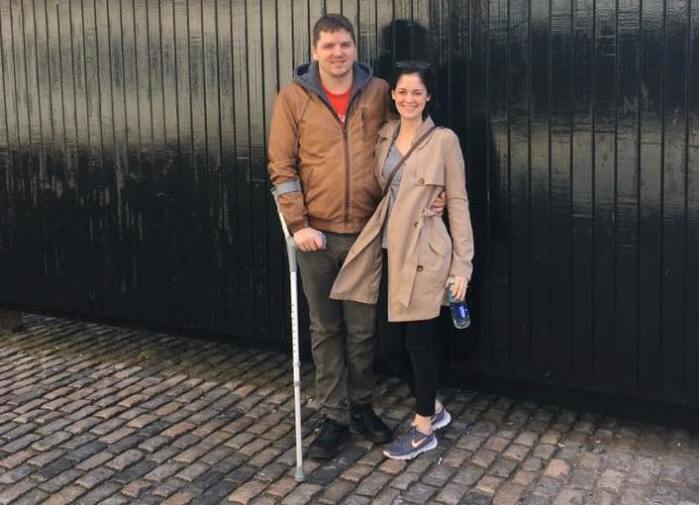
On top of that unpleasant surprise, there’s a larger, more worrisome issue on our hands. James broke his foot when he was in military college years ago. After a misdiagnosis by the UK’s healthcare system, James’ foot condition worsened. He was constantly breaking the same foot or feeling excruciating pain even if the bone wasn’t broken. I’ve watched him suddenly buckle over in severe pain, tears welling up in his eyes, unable to speak for no understandable reason. He has logged more hours at the hospital in the last year than you probably have in your entire life. And I’ve never been able to be there in person for him. Nearly half of our relationship, James has been on crutches or wearing a cast, unable to move around like an average human being. He used to be a marathon runner, and now he has to stop and take breaks when the pain gets to be too intense. Specialists have examined his foot so many times we’ve lost count, and I’m sure all of the area doctors know his case by heart simply due to the amount of times he’s had to call and leave messages asking for a different kind of pain medicine because whatever they gave him this time wasn’t helping. He’s ingested so many terrifyingly strong pain medications and narcotics that I worry about the state of his organs and the tolerance his body has built up. After countless MRIs and X-rays, doctors believe he has Complex Regional Pain Syndrome (CRPS) and Allodynia. He’s had several surgeries, including one a few months ago to kill a nerve in his foot to stop all feeling whatsoever. We pushed for the surgery because he wasn’t responding to pain management medications, and also because I really wanted to dance with my husband at our wedding in February. The surgery worked and he was walking around normally and we allowed ourselves to celebrate and get excited to dance at our wedding…  And then the chronic, crippling pain was back within a month or two and our hearts were broken. That phone call with James was probably the worst, most painful conversation I’ve ever had in my life. The doctor had told James he could run again in as little as three years, and now the boot is back on and the crutches are always at the ready. We thought we saw the light at the end of the tunnel. We were excited! And yet again, we were let down. Now, doctors see that two bones in James’ foot have fused together and need to be surgically separated. Until then, he will repeatedly break his foot because of the added pressure the fused bones place on his foot. However, his hypersensitivity and CRPS make it too risky to pursue this surgery until doctors can figure out a way to manage the pain. And although most Americans don’t understand this because we don’t have healthcare like the UK does, the wait time for James to see someone at the pain management clinic is, AT THE EARLIEST, 3 months from now (thanks, universal healthcare). So not only do I have to helplessly sit here in America while my other half is in agonizing pain every single day (physically and emotionally), I also have to stomach the notion that James may never find relief – or worse – it may worsen or spread to other parts of his body. I do the best that I can to be supportive and positive because scary health situations like this are best combatted by a strong, optimistic team. But it takes nearly all my strength not to break down myself, and I’m not the one dealing with the physical pain. I selfishly had this image of James and I dancing with big goofy grins on our faces to our song in 10 weeks, and now I’m trying to figure out a way to dress up his crutches to match the venue decor.

While there’s nothing we can do at this moment except stay positive and hopeful, it’s still hard to deal with. Even though James no longer holds the job that kept him in London away from me, he still has to stay in London now in order to remain with the doctors who have been working closely with him. Why doesn’t he come to America, you say? It’s been discussed, but American healthcare is astronomically expensive, which is an obstacle we simply can’t get around financially. And even if we could, it takes a minimum of a year for a non-US citizen to have their visa application accepted in order for James to remain here with me.

It has been an incredibly tough year for James and me. We have faced so much adversity, and sometimes it feels like it’ll never end. But I have to keep the faith because James deserves the best in this world, and if I can’t fix these problems, I can at least give him my best.

I chose to write this post because I think it’s important for everyone to remember that we are all fighting our own battles even if others can’t see them. We should not judge or criticize others for things we do not understand, and we should always hope for the best for people no matter what. I know our situation could be much worse, but for now, this feels earth-shattering. So please be kind to one another and help each other out. Even if it’s just listening when someone needs to vent or offering a hug to help someone de-stress – almost any little thing can help. Trust me, I can attest to that! James will be pain-free some day soon and we’ll get to live in the same place because that’s the only future either of us will accept. We’ll get there because we want to. In the meantime, we’ve got the power of positivity on our side and an absolute unwillingness to give up. And one day, at our vow renewal, James and I will dance without reservation!

When the world starts falling apart around you, all you can do is start picking up the pieces and putting them back in an order you can understand. And that’s what we’re trying to do.

To infinity and beyond!

The cost of love

Image

When you’re young, you never associate paperwork and deadlines with a wedding. Planning a wedding is meant to be romantic and exciting, and it’s supposed to be that “making your dreams come true” kind of time. Dresses and tuxes and flowers and dates and parties and venues – all of these things happily float around in your head until it all comes together, culminating in the best day of your life. Well, that may be true if your significant other has the same nationality as you. You could throw together a wedding tomorrow if you were in a rush and get on with your lives together immediately! But some of us aren’t that lucky.

I love my fiancé more than life. I’m so happy I met him and I’m thrilled to some day call him my husband. But while I’m still excited to actually get married, the planning process of figuring out how to actually marry my English fiancé has almost completely sucked the excitement out of my engagement. Isn’t that awful? Here’s why:

For my fiancé to come here, we would have to apply for a visa. Have you seen or heard of the show on TLC called “90 Day Fiancé?” It’s kind of like that, except way more complicated. If you happened to watch the program, you’ll have noticed that when it first started, each couple mentioned how they’ve been with his or her significant other for at least a year or more. That duration is important to note because that means there was about a 6 month block of time where they were just sitting around waiting for the visa to simply get accepted. Why would it take that long? Well, to get what’s called the K-1 Visa, there are roughly one thousand steps. First, you have to simply petition for the visa. That’s not applying, folks. You have to state your case before you can even apply! And this petition, in which you must provide biographic information (proof of citizenship, census evidence/school records or/certificates of religious rites/every minute detail of your personal existence), a police certificate (preferably a clean one!), evidence showing that you plan to marry within 90 days of entry in the U.S., evidence that you have met in person, more forms (G-325A) specially formatted passport-style photographs taken within 30 days of filing the petition and other little details are all for the low, low cost of $400! After all that stuff is turned in, then the U.S. government may still turn around and request more evidence or require you to be interviewed before accepting your petition. When and if your petition is accepted, THEN you can apply for the actual visa. This part also includes the interview. You know, like in the movie The Proposal when Sandra Bullock and Ryan Reynolds try to get married. Seriously, it’s very similar. If all your paperwork checks out and you can prove on paper that you’re not making up your whole history and relationship, then you have to sit before a government employee and answer any questions they want to ask about you and your relationship. I’ve been told that these questions can get quite personal as well, so that sounds fun, huh? I guess you just have to hope that your relationship sounds legitimate! Plus, at this interview, you’ll also have to bring with you an incredibly insane amount of more paperwork and evidence. This stuff includes things like medical records and a recent examination demonstrating your current health, evidence of financial support (I-134) that proves that your partner will never become a financial liability on the U.S., more evidence of the relationship’s validity, more photos and, of course, payment of all the fees involved. And again, even after all this, the government can still ask for MORE. Waiting for all of this to come through can take anywhere from a few weeks to a few months.. or a year. So let’s say after all this work, the visa is approved and your partner can now come and marry you in the U.S. When they show up and go through customs, there is still the possibility that they are not granted admittance into the country. Nice, huh? If you can pass go, then you’ve got 90 days to tie the knot or get gone, buzzo! Once that rushed marriage has taken place, you can apply for a green card to become a permanent resident. Yup, more paperwork, more waiting and more gambling. Even if you’ve gotten married, you can’t legally work in the country until you’ve applied for and been granted authorization to do so (I-485). So after you’ve dropped a couple thousand dollars on applications, petitions and forms, you may have tallied anywhere from 6 to 8 months worth of just waiting. Let’s hope that through all that stress, you were still able and excited to plan your wedding to take place in that 90 day time block!

What’s more is that while you’re waiting for your significant other to be able to move to you and be with you for good, you put your visa acceptance at risk if you plan any long visits to see each other during the waiting period. Why? Well, you have a love interest in the country and you’ve already expressed a desire to stay with them, so who’s to say you won’t just pop over for a visit and then never leave? Can’t have that! That’s illegal immigration!

So after I became frustrated and concerned that I couldn’t personally meet the threshold of the minimum income requirement to prove financial stability, and how the wait time was anywhere from half a year to 8 months, I turned to see if UK immigration was an easier process. Although very similar in terms of the process, I found that the red tape was a little looser and more flexible. Financial requirements aren’t as rigid and allow for more options, the paperwork and applications are processed and accepted (or denied) in a much quicker time frame (as soon as a few weeks!), and there aren’t fees on fees on fees each time a new form is filled out. However, the process is still just as much of a gamble, still very costly, very demanding and stressful and more or less the same as the U.S. process. The main things that appealed to me were the possibility of moving quicker and the ease of understanding the application process.

So while we wait the required 6 months that is necessary since we both accepted new jobs and need to do so in order to meet the financial requirements for either country’s visa, all I can do is anticipate and prepare as much as possible for the upcoming work involved in getting married. Now you can see why it’s upsetting and difficult to plan your long-awaited for wedding (seriously long) when you’ve got so many other things on your mind! The outside support from friends and family who are genuinely excited for our happiness helps redirect the focus from paperwork to bliss. Nevertheless, as with many things in life, there are naysayers that chime in, and sometimes it seems they’re louder than the cheerleaders. Love found across countries is a seesaw dipping back and forth between pure joy and stress.

And although I wouldn’t trade my fiancé for anything or anyone in the world and I don’t regret saying yes to marriage, I urge you to look at your own situation and learn to appreciate things that you two can do that isn’t a guarantee for others. Be able to look at your relationship and say, “yes, this IS a lucky kind of love” and learn to stifle your complaints about doing long distance or arguing over where you want to live or what have you. There are always ways in which it could be harder and there will always be people out there who may have things a bit more complicated. Love your love and always be grateful. And always remember, through any and all the stress, you’ve always got each other. Together is where you want to be, and do what you’ve got to do to get there. Whatever it takes!